Writing. Painting. Music. Photography. Video. Animation.
There are so many different art forms. Each one is different, yet incredibly complementary. Especially when the unifying element becomes the music.
In this article we’re going to look at music videos – no, not the greatest – more like, the most definitive. Those which changed and pawed the way for todays ‘over the top’ videos. Nowadays, music videos broadcast on MTV, VH1, etc. music channels are full of gorgeous shots, extravagant effects, and tons of bass beats. They are like sugar cotton candy in the middle of an amusement park, where roller coasters flashes by, while fireworks shoot overhead. You have to admit – some of today’s videos are so gorgeous, you can’t help but wonder if they haven’t been smeared with some hallucinogenic mushroom instead of a cotton candy? (see Aphex Twin – T69 Collapse)
However, not always such has been the order of things on the music video front. Thus, I invite you to step into a time machine and look back in time at those few clips, which, in my humble opinion, once changed the understanding of what the words “Music Video” mean in people’s minds, and hopefully you will find out something new and interesting.
This list includes just seven songs that marked the development of music videos – mostly technically, but also historically – up until the clips we are used seeing today, where without simple lyrics and camera shots, today’s music videos combine painting, 3D animation, photography, and other art forms. Of course, this list could be larger than just seven, but let’s keep it short, definitive and rather sublime.
Bob Dylan – Subterranean Homesick Blues (1965)
This list opens with Bob Dylan’s song “Subterranean Homesick Blues,” which was released in 1965 and was the lead single from his fifth studio album, “Bringing It All Back Home.. While this song was Dylan’s first to enter the US Billboard Top 40, most people remember its video version. What’s so special about it?
Up until the 1960s, the most common music video format was concert recordings or feature films, where the music served more as a narrative (for example, The Beatles’ 1964 comedy “A Hard Day’s Night”).
Bob Dylan’s “Subterranean Homesick Blues” is one of the first (and definitely most popular of that year) videos, where the material was created with the aim of promoting the song itself, thus obtaining a related version of the modern concept of “music video”.
In this clip Dylan – who also came up with the idea – holds signs with the lyrics of the song and drops them to the music’s lyrics. The video deliberately misspells some words, for example, where the song says “11 dollar bills”, the video says “20 dollar bills”.
This very same video has helped to inspire countless other artists throughout the history.
Queen – Bohemian Rhapsody (1975)
Who doesn’t know Bohemian Rhapsody? The song’s fame is so surreal, it doesn’t require any further comments about its popularity.
Some consider the “Bohemian Rhapsody” to be the first true music video in history (although, Dylan’s “Subterranean Homesick Blues” was made ten years prior) and today attribute this video to pioneering the form of music videos, which would later be broadcast on MTV.
By 1975 many musicians had created music videos for their own songs, including Queen themselves (the 1974 video for “Killer Queen” being as one such example). But it wasn’t thanks to the success of “Bohemian Rhapsody”, that it became common practice for record companies to produce music videos for individual songs.
The video’s iconic opening features the entire band standing in near darkness, singing cappella. The shot’s composition is exactly the same as the band’s studio album “Queen II.”
By the way, when I published this very same article in 2019, the number of views for this official music video on YouTube just recently had reached 1 billion mark. Today in 2025, when I am re-translating this very same article in English, “Bohemian Rhapsody” music video is just steps away from reaching 2 billion view milestone.
Talk about the classic’s renaissance in the digital age…
The Buggles – Video Killed the Radio Star (1979)
It would be a blasphemy not to include this song on the list. The Buggles video was the very first in history to be broadcast on MTV, when the channel just launched in USA on August 1st 1981. The name of the song? Ironically, it was “Video Killed the Radio Star”. Although the future would prove otherwise.
It was written in 1978 by three musicians – Trevor Horn, Jeff Down and Bruce Woolley. It was originally performed by Bruce Woolley with The Camera Club for their album “The English Garden”. However, Trevor Horn and Jeff Down showed the middle finger and responded to these efforts with their own version of the same song, creating a group called The Buggles. The rest became history.
From the title alone meaning of this song seems to be clear. “Video Killed the Radio Star” is about musicians’ mixed feelings about 20th-century inventions, which – they liked it or not – slowly made their way into the music front.
The video for the song was not only the first to be played on MTV back in 1981, but also more recently – in 2010, as VH1 Classic replaced MTV Classic in the UK, and even then, this song traditionally played as the very first in line. This music video originally cost around $50,000 and, if you look truly closely, it briefly features the famous contemporary film composer Hans Zimmer at the synthesizer.
Sting – If You Love Somebody Set Them Free (1985)
The eighties already marked the production of music videos at full throtle. Record companies commissioned clips for the most popular songs. The artists themselves craved for the most creative clips, even if it meant using archaic computer effects. And in 1984 MTV began giving out annual awards for best music videos. The competition for – who will create the best music video – had begun.
Therefore, it isn’t surprising that Sting, shortly after the breakup of The Police, also tried to start his solo career with the brightest technical possibilities out there.
Very underrated clip for a song which has found place on this list is the “If You Love Somebody Set Them Free” video. From certain perspective this song can be considered as Sting’s first solo outing – in 1985 this was the first song on his solo debut album “The Dream of the Blue Turtles“.
The song’s music video is special in a way that it was one of the first (if not the first) attempts to use rotoscoping in music video creation. Rotoscoping is a video processing technique where an object, positioned against a green background – or popularly called a green screen – is filmed and later cut out separately in frames. Who doesn’t know this technique today? But back then it was like trying a blind shot in the dark.
In this song, each of the musicians was also filmed separately, cut out and then combined into one common background. The end result is quite a unique material, a fairly creative product for the 80s. Although this music video clip did not become memorable, the song itself did and still today is considered by many fans as one of his classics.
Dire Straits – Money for Nothing (1985)
If “Video Killed the Radio Star” launched MTV USA, then “Money for Nothing” was the first music video to be played on MTV Europe back in 1987.
I firmly believe I’m not mistaken when saying that the rock band Dire Straits doesn’t have a more popular song than “Money for Nothing”. And the same can be said about song’s video. It was one of the first music videos of the time to use computer-animated characters and therefore was considered a very complex, innovative video for its time
The band’s leader Mark Knopfler was initially against it and did not sign up for such a thing. He was said to be quite dismissive of music videos for his songs, because he believed that they “robbed the songwriters of their enlightenment”. However, his girlfriend convinced him, emphasizing that there were not enough interesting videos on MTV at th time. After all those were the times when MTV wasn’t filled with silly reality shows, but with true music videos.
Still today it isn’t quite clear how much exactly this video cost, but it was created with the help of a Bosch FGS-4000 CGI system. As we know, today Bosch is more associated with construction tools and car parts, rather than computer systems.
But the effort was well worth it, as the music video clip received the Award of the Year at the 3rd MTV Music Awards ceremony in 1986. And how damn catchy the song’s guitar opening is!
By the way, another interesting fact – the quiet lyric the beginning of the song saying “I want my MTV” belongs to Sting himself. Knopfler had previously met Sting and admired his voice, so he reached out to him, and Sting agreed to lend his vocals for this track.
a-ha – Take on Me (1985)
What a year 1985 was on the music front! If you look back at the MTV awards ceremony, that year there were names like Tina Turner, Phil Collins, Robert Palmer, Bruce Springsteen, Bryan Adams, Kate Bush and also newcomers like Simply Red and a-ha.
Although the famous Norwegian pop group a-ha was founded in 1982, it became recognizable to the wider public audience in 1985, when its debut album “Hunting High and Low” was released, including the phenomenal track “Take on Me”.
Like “Bohemian Rhapsody”, the song “Take on Me” also requires no additional comments (as of April 2025 already has reached the title of 2.1 billion views on YouTube). Perhaps even better known to everyone is its video, where live-action or real-life filmed scenes smoothly merge with one another through drawn shots. Because of this aspect, the clip was a utopian work for its time, as it included the same rotoscoping technique, but where each frame was stopped so that it could be drawn. In the end, about 3000 frames were rotoscoped, which took 16 weeks (!).
This very same technique, although on a smaller scale, was also utilized in other a-ha videos from the same album – “Train of Thoughts” and “The Sun Always Shines on TV”, thus becoming a-ha’s ‘little rotoscoping trilogy’.
Although “Take on Me” is a visually powerful video, that year it lost to the already mentioned Dire Straits “Money for Nothing” at the MTV Awards ceremony. However, both of them paled in comparison to the next year’s winner, which was…
Peter Gabriel – Sledgehammer (1986)
The absolute triumphant of this small but noble list (if we call it that way, because, you know, this wasn’t a comparison list after all) is without a doubt Peter Gabriel with his smash hit “Sledgehammer” from the famous album “So”.
The song was released back in 1986, on April 25 and quickly shot to the top of several song charts in different parts of the world. But its popularity was largely contributed by its video.
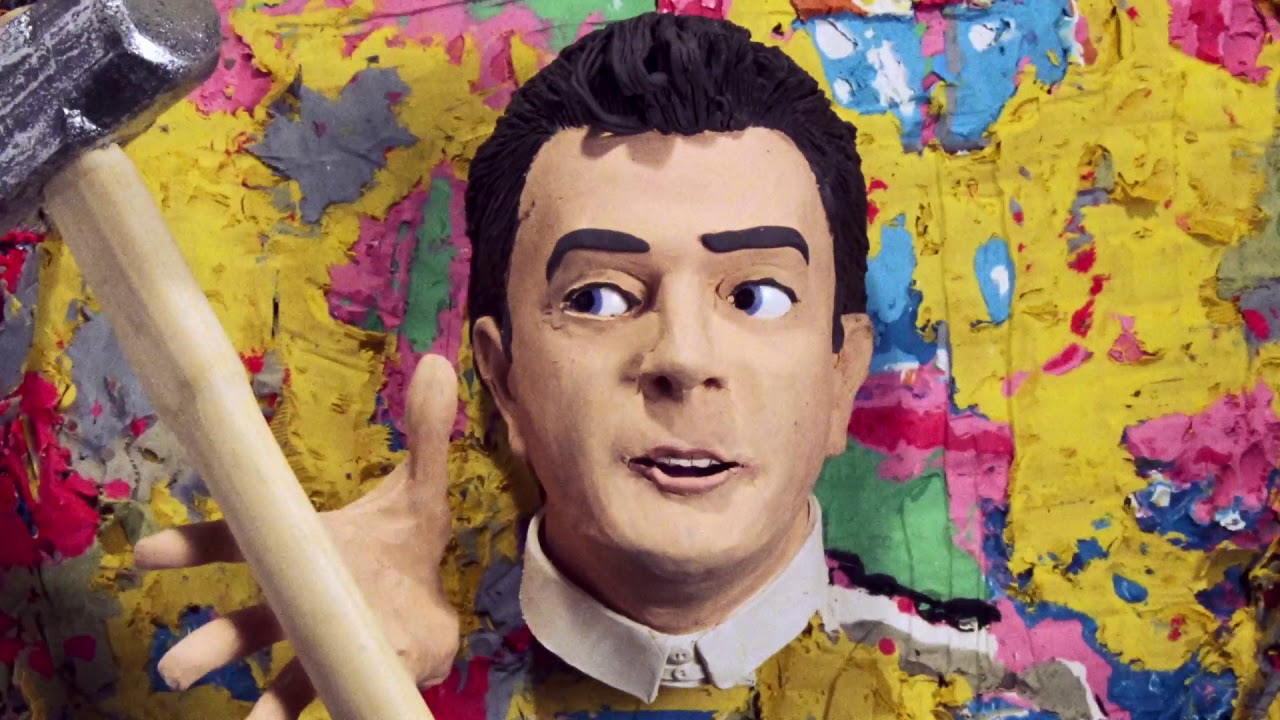
And this time, no rotoscoping, no computer-animated characters. Just live-action shots, which were achieved by gluing plasticine and photographing every single second frame (one second could usually have an average of 25 frames). Technique which is well known in the industry as stop motion.
Stop motion was achieved by Gabriel lying under glass for 16 hours per day without moving, while artists glued the plasticine together for each frame separately.
“It took a lot of work,” Gabriel said in an interview, “I thought at the time, if someone wants to repeat it and copy me – good luck to them!”
In a way, Gabriel also later copied himself with another song of his “Big Time”. Other Peter Gabriel videos are also examples of what a technically complex, vivid music video should look like, but it must be admitted – after “Sledgehammer” he never managed to repeat the same success in the term of ‘highlight music video’.
By the way, the song is about sex. The words “train, bumper cars, and the big dipper” are applied to a man’s penis. Welcome a visually beautiful, family friendly song!
That year “Sledgehammer” music video received several Video of the Year awards and is still considered the most played song in the history of the MTV channel.
 M.Perkons